









By MeaCulpa (Empowered by AI)
In 2006, the Nebraska Cornhuskers football team was still chasing echoes of glory. Their proud program had built its reputation on preparation, discipline, and film study. But behind the scenes, the workflow hadn’t caught up with the times. Coaches were still swapping DVDs, burning late nights in the film room, and handing players thick manila folders stuffed with notes.
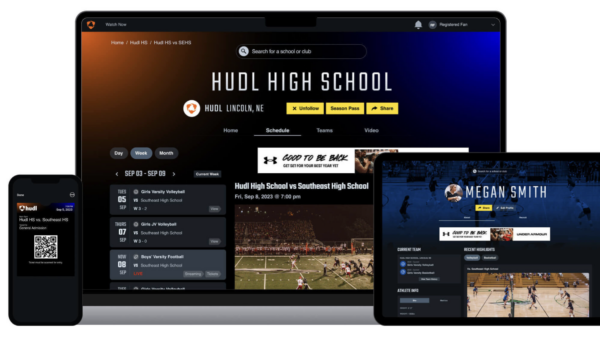
That’s when a graduate student named David Graff decided to solve the problem. Alongside classmates Brian Kaiser and John Wirtz, Graff developed a way to put game film online—accessible anywhere, instantly, without the grind of copying discs.
“We were just trying to make life easier for Nebraska coaches,” Graff would later say. “But once we showed it to them, we realized we weren’t just solving a Husker problem. We were solving every coach’s problem.”
Nebraska football became Hudl’s first customer, lending the young startup credibility that few college students could dream of. With Husker athletics as a testbed, Hudl suddenly had a proof point that carried weight in locker rooms across the country.
“We built Hudl to make it simple for coaches to win, and for athletes to get better every day.” – John Wirtz
Spreading from the Sidelines
At first, Hudl pitched itself to other elite programs. If the Huskers could use Hudl, why not Texas or Michigan? The early sales came, but Graff and his co-founders quickly realized the real growth engine wasn’t at the top of the sport, it was at the base.
High school coaches were desperate for tools that could save them time. Parents wanted their kids’ highlight reels to be visible to recruiters. Hudl became not just a coaching tool, but a pipeline to college athletics.
“When we started working with high schools, we knew this was the future,” Graff recalled in an interview. “There are 16,000 football programs in the country. If we could serve them, we could build a real business.”
By the early 2010s, Hudl had become a household name on Friday nights. Players reviewed their plays on Saturday mornings, recruiters browsed Hudl profiles, and small-town teams suddenly had access to the same tech used by national champions.
The Founder’s Perspective
Hudl’s co-founders never pretended they were Silicon Valley prodigies. They were Nebraska kids who loved football and knew how to code. That humility became part of Hudl’s DNA.
“Being in Lincoln forced us to think about real customer problems,” Wirtz said. “We weren’t distracted by hype. We were listening to coaches and athletes.”
That focus resonated. Instead of chasing trends, Hudl doubled down on its mission: save coaches time, help athletes get better.
“We wanted to show that world-class companies can be built in Nebraska—and we’ve never wavered from that.” – David Graff
The Leap to Global Sportstech
Hudl’s real transformation came through a string of strategic acquisitions:

- In 2015, Hudl bought Sportstec, the maker of Sportscode, the gold standard for elite video analysis used by pro teams worldwide. Suddenly, Hudl wasn’t just serving Friday night football—it was in Premier League locker rooms and Olympic training centers.
- In 2019, Hudl acquired Krossover, a service that delivered fast, professional game breakdowns. Coaches who once spent Sunday afternoons tagging film now had ready-made data by morning.
- Later that year, Hudl purchased Wyscout, the global soccer scouting and transfer database. Overnight, Hudl became an essential tool for European football.
Each deal expanded Hudl’s reach: youth leagues, high schools, elite colleges, professional clubs. Few competitors could match that range.
Hardware + Software: Hudl Focus
In 2017, Hudl launched Hudl Focus, a family of smart cameras that automatically captured games and practices. No volunteers. No missed plays. Footage uploaded instantly to Hudl’s servers.
For overworked high school coaches, it was revolutionary. For Hudl, it was a way to lock in customers even deeper. Once a Focus camera was bolted above a gym or stadium, switching away from Hudl became unthinkable.
Investors with Conviction
Hudl’s dominance also came from smart backing. Nebraska’s Nelnet was an early investor, and their public filings offer rare windows into Hudl’s business.
In its 2024 Form 10-K, Nelnet described Hudl (Agile Sports Technologies, Inc.) as its largest venture holding, valued at $168.7 million with a 22% ownership stake. More telling, Nelnet noted that Hudl’s “fair value is significantly greater” than what the books showed—a hint that Hudl’s true worth may be unicorn-level or higher. “Nelnet believes Hudl’s fair value is significantly greater than its $168.7 million carrying value.”
In 2020, Bain Capital Tech Opportunities joined the table, giving Hudl the resources to pursue global expansion and AI-driven product development.These moves gave Hudl something few sportstech companies achieve: stability and long-term vision.
Athlete Impact
While the founders often tell the story from the boardroom, the real impact is felt on the field. Ask any Nebraska high school athlete from the last decade, and chances are they’ll tell you Hudl shaped their path.
Former Husker linebacker Chris Weber once credited Hudl with helping him understand the game better as a recruit. “I could break down plays myself before I even got to Lincoln,” he told local reporters. “Hudl gave me a head start.”
High school volleyball players across Nebraska use Hudl to share highlight reels with recruiters. Basketball players upload clips to showcase their skills for college scholarships. Hudl isn’t just for football—it’s become a platform for every sport, every athlete, every dream.
Nebraska’s Sportstech Cluster
Hudl’s success seeded a local ecosystem:
- EliteForm helps strength coaches monitor power and velocity in the weight room.
- Opendorse became a leader in NIL marketplaces for athletes.
- ScoreVision builds smart scoreboards and fan engagement platforms.
Silicon Prairie News calls it Nebraska’s “sportstech flywheel”—a cluster of companies that exist because Hudl proved it could be done.
Together, these companies employ thousands, attract venture capital, and keep Nebraska on the national map for innovation.
Why Hudl Still Dominates
Hudl’s edge lies in its ecosystem:
- Capture: Hudl Focus cameras.
- Analysis: Hudl Assist, Sportscode, Krossover.
- Scouting: Wyscout.
- Distribution: Athlete highlights, recruiter access, fan engagement.
Once a team adopts Hudl, the cost of leaving is enormous—not just in money, but in time, trust, and data continuity.
Looking Ahead
Hudl is already experimenting with AI: auto-tagging plays, predictive scouting, performance insights. With Bain and Nelnet’s confidence, it has the runway to keep innovating.
And through it all, Hudl remains anchored in Lincoln, Nebraska. The same film room roots that started it all still shape its culture: humble, practical, focused on making coaches’ and athletes’ lives better.
“At every level, from Friday nights to global finals, Hudl is the system of record for sports performance.”
Conclusion
Hudl is more than a unicorn. It is Nebraska’s calling card to the world. Born of Husker grit, sharpened in high school gyms, expanded through global acquisitions, and validated by serious investors, Hudl stands as proof that world-class companies can thrive in the middle of America.
And as Nelnet’s filings hint, Hudl’s story isn’t finished—it’s still scaling, still innovating, still helping the next generation of athletes chase their dreams.
Sources
- Silicon Prairie News reporting on early Haymarket days and key acquisitions.
- Hudl company materials on funding, acquisitions, and products (Sportstec, Krossover, Wyscout; Focus cameras). Hudl+4Hudl+4Hudl+4
- AP/PR News coverage of Focus Outdoor. AP News
- Bain Capital investment announcement (2020). Bain Capital
- Nelnet (NYSE: NNI) 2024 Form 10-K: investment size, ownership, and global scale disclosures related to Hudl. StockLight