















by Mea Culpa (Empowered by AI)
FuturHerd Solutions is quickly becoming one of the most compelling ag-tech startups in Nebraska. The company is built around the mission of improving nursery-phase pig health and efficiency,
The company is developing the Nursery Nanny, a robotic device that encourages newly weaned piglets to move, eat, and drink—an intervention that can reduce mortality and improve growth outcomes. The idea sits at the intersection of science, hardware innovation, and everyday livestock challenges, which is exactly why the startup has gained early momentum and statewide attention.
A meaningful part of that momentum comes from Nebraska’s Innovation Fund Prototype Grant, which can unlock up to $150,000 for companies building new technologies. FuturHerd has used early matching funds—such as its LaunchLNK award—to qualify for and leverage that prototype support. For hardware-heavy ag-science companies, this capital is transformative: it makes it possible to engineer prototypes, run on-farm trials, and refine robotics systems that would otherwise be cost-prohibitive. In livestock technology, where reliability is non-negotiable, that prototype stage is everything.
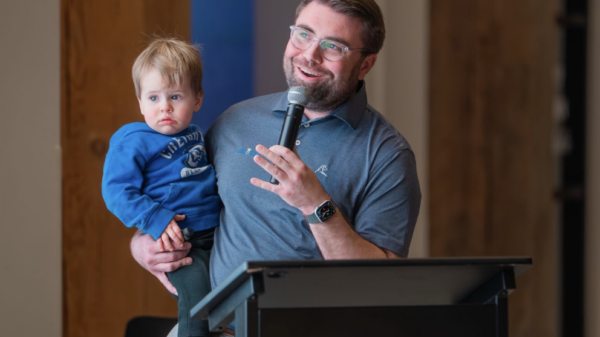
Driving this work forward is co-founder Brooke Parrish, whose academic and industry background make her uniquely positioned to tackle swine-nursery challenges. Parrish is not only a founder; she is a scientist deeply embedded in the field. With a B.S. in Agribusiness, an M.S. in Animal Science, and ongoing doctoral research at the University of Nebraska–Lincoln in Animal Health, Welfare & Precision Management, she brings both rigorous research and real-world livestock experience to the startup.

Her Ph.D. work involves studying behavioral and physiological responses to stress in both swine and feedlot cattle, including research using the NUtrack Livestock Monitoring System—a technology that captures real-time behavior, movement, and welfare indicators. This gives her a firsthand understanding of how early-life stress shapes health outcomes for pigs and why the weaning period is such a critical intervention window.
When featured by the Lincoln Partnership for Economic Development (LPED), Parrish summed up her motivation simply but powerfully: “I was excited about the opportunity and understood its potential impact on the swine industry.” Like many startups, Parrish’s new ag-tech company has received significant support from the Lincoln startup ecosystem – beyond startup funding from LPED and the Business Innovation Act’s prototyping program.
By grounding robotics innovation in real animal-science research, FuturHerd—and Parrish in particular—embodies what Nebraska’s prototype program was designed to champion. It’s ag-tech rooted in evidence, tested in real barns, and built by leaders who understand both the science and the stakes.